
Religion and personal beliefs often play a central role in shaping values, worldviews, and social expectations. When partners come from different religious or cultural backgrounds, or even when one partner is deeply spiritual and the other secular, differences in faith can influence communication, conflict resolution, long-term goals, and daily lifestyle.
In the context of an international relationship or a cross-cultural union, the question “is religion important in a relationship?” becomes more than theoretical: it becomes operational. Empirical evidence suggests that religious compatibility (or lack thereof) can significantly impact marital satisfaction, stability, and relational conflict.
Thus, when you and your partner are navigating faith differences, or want to understand the religious relationship impact on your future together, it pays to treat spirituality and religion as one of the structural dimensions of your ethics and religion relationship plan, akin to finances, children, or cultural identity. This is especially relevant in cross-cultural relationships, including slavic dating, where spiritual traditions and values often play a meaningful role in personal identity and family life. The rest of this article walks through how to understand, discuss, and integrate religion and beliefs in a relationship, with special reference to Ukrainian religious customs, but with broader principles that apply globally.
Understanding Her Faith and Practices
How to improve communication in a relationship for that? Before you can meaningfully discuss culture’s impact on your relationship, it’s essential to understand what her faith actually means to her, not what you assume religion to be. Belief systems vary widely in intensity, ritual observance, community engagement, and interpretation.
Religiosity is multi-dimensional: according to a factor-analytic study of global survey data, dimensions such as Religious formation (family or upbringing), Religious practice (rituals, church attendance), Belief in God, and Supernatural beliefs can diverge significantly — meaning two people who claim the same faith may actually differ profoundly in how religion shapes their lives.
Therefore, begin by asking concrete questions about ethics and religion relationship:
- How often does she attend religious services, pray, or engage in rituals?
- Is religion central to her identity, or more about tradition and cultural heritage?
- Does she expect religion to play a role in future children’s upbringing (baptism, holidays, moral education)?
- How does religion influence her values about family, gender roles, community obligations, or moral decisions?
Understanding her faith means profiling not just her declared affiliation, but how religion functions in her everyday life, values, and future expectations. Without this clarity, any religious “compatibility” assumed on paper may be unstable in practice.

Ukrainian Religious Customs
If your partner is Ukrainian (or has a Ukrainian religious background), it’s useful to know some of the broad contours of religious affiliation and practice in Ukraine, though individual variation remains large. According to a 2023 survey by the Razumkov Centre, about 61% of respondents identified as Orthodox Christians; a significant minority identify as Greek Catholics (≈11%), and another portion define themselves more loosely as “just Christian.” The share of those who declare no religious affiliation has recently increased to ~13%.
Another observation: many Ukrainians may identify with their culture, but religion is often not the primary axis of identity. In the Razumkov survey, when asked which social group they identify with first, only 2% picked “people of same faith/church.”
In practice, Ukrainian religious customs often blend formal ritual, cultural tradition, and modern secular life. For example:
- Baptism and choosing godparents remain common rites in Orthodox and Greek-Catholic communities, often seen not only as spiritual but as social safeguards for children.
- Many families continue to observe religious holidays (Easter, Christmas) and family-centric rituals, even if they do not attend church regularly.
- There may be regional or generational variance: in more rural or conservative areas, religious commitment tends to be stronger, while urban or younger populations may lean more secular or treat religion as cultural identity rather than doctrinal commitment.
Recognizing common Ukrainian religious customs gives you context, but it doesn’t replace the need to ask your partner about her personal practices and beliefs. Cultural affiliation does not guarantee religious behavior or expectations.
Daily Rituals and Spiritual Habits
For many believers, faith manifests not only in weekly services but in daily rituals: prayer, meditation, grace before meals, religious reading, or rituals around holidays and seasons. These practices shape mood, decision-making, priorities, and even lifestyle choices (dietary restrictions, alcohol, social gatherings, time use).
From psychological studies: regular shared religious practice in couples (e.g. attending services together, praying together) correlates with greater marital adjustment and satisfaction, especially in homogamous unions (same faith).
Therefore, when you enter a relationship where religious habits may diverge, it’s important to map out, early, how daily and weekly spiritual habits will (or will not) integrate. Ask questions like:
- Will we attend religious services together, or separately, or not at all?
- Do you expect children to be raised according to your faith? Which rituals matter (baptism, holidays, moral instruction)?
- Do you foresee lifestyle accommodations (diet, abstention, celebration) tied to faith or tradition?
Daily spiritual habits are low-key but powerful signals of commitment and identity. Consider this to improve relationship. If they are ignored in planning, they will emerge organically, sometimes as friction between habits, expectations, and habits.
Exploring Your Own Beliefs
Before negotiating your partner’s religious background, you need certainty about your own beliefs: not only what you believe, but how much religion matters to you in daily life, long-term goals, parenting, and moral decision-making.
Use the four-factor model of religiosity as a guide (religious formation, practice, belief in God, supernatural belief) to self-assess. Then consider:
- Which aspects of religion (ritual practice, moral framework, community involvement) matter to me, and which don’t?
- How flexible am I in accommodating someone with different levels of religiosity or different faith tradition?
- What are my deal-breakers (e.g. expectations for children’s religious upbringing, church attendance, religious holidays)?
- Am I entering a relationship hoping to influence or change my partner’s beliefs, or to respect them as they are?
Self-reflection prevents projection. Clarifying your position gives you a stable base from which to negotiate religious compatibility, and avoid misunderstandings or resentment.
Discussing Religion Openly
How to improve your relationship with faith and belief? Honest conversations about religion early and repeatedly is one of the most effective ways to prevent misunderstandings, or latent conflict. Here are recommended practices for open religious discourse:
- Use “I” statements: speak about your beliefs, fears, expectations – rather than making judgments or assumptions about your partner.
- Ask open-ended questions: about what religion means to them, what rituals matter, what their hopes are for the future (children, holidays, moral education).
- Map differences and overlaps: note where you align (values, ethics, beliefs) and where you diverge – and whether those divergences matter for long-term goals.
- Revisit the conversation over time: beliefs and expectations evolve; a conversation that seems finished can morph as life circumstances change.
Open discussion is not a one-time event, it’s a relational protocol. Continual check-ins help ensure both partners stay aligned ethically and spiritually, and improve your relationship.
Navigating Religious Holidays and Traditions
Religious holidays and traditions are high-salience landmarks in personal and cultural identity. But when partners come from different faith backgrounds, these landmarks can clash without careful planning.
Important considerations include:
- Calendar overlap and conflict: Some holidays may coincide, or observance of one may require travel or rest, which can conflict with the other partner’s secular or alternate holiday calendar.
- Ritual meaning vs. social expectation: For one partner, a holiday may be deeply spiritual; for the other, purely social or even optional.
The ways to improve relationship:
- Create a shared calendar of significant holidays (religious, cultural, familial) for both partners.
- Decide together which traditions you will follow jointly, which you will observe separately, and which you may forego or adapt.
- Establish rituals of mutual respect: even if one partner doesn’t participate, showing support (e.g. attending, giving space, helping with planning) helps maintain harmony.
Navigating religious holidays in a mixed-faith relationship is less about choosing “whose holiday” and more about building a hybrid ritual calendar, one that respects both partners’ traditions without forcing zero-sum choices.
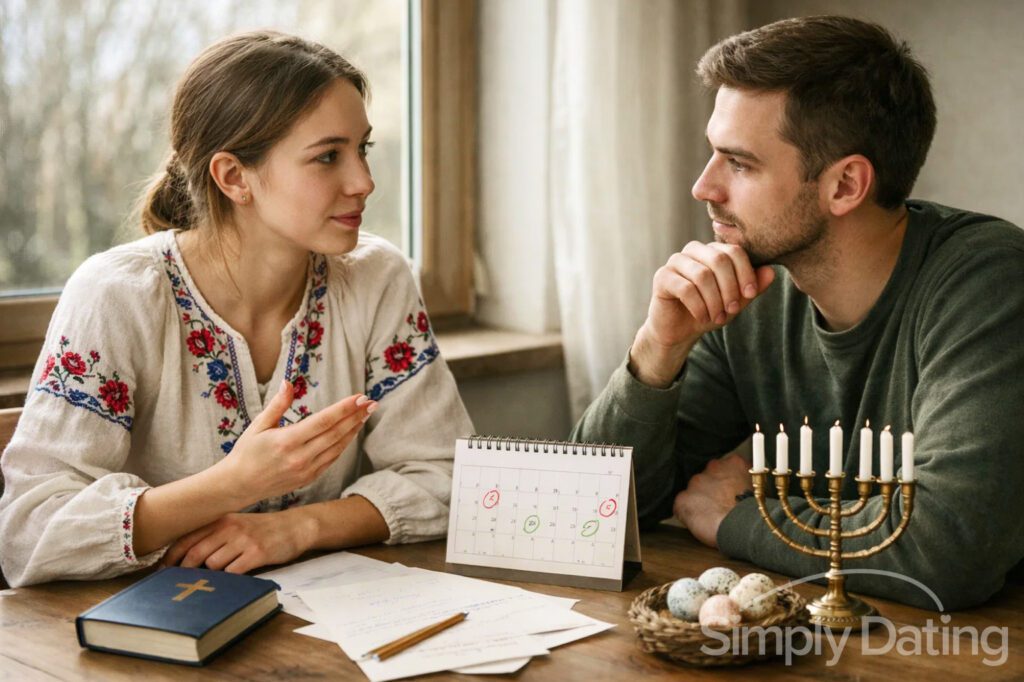
Tips for Open and Honest Conversations
Here are practical tips to guide open and honest conversations about religion and beliefs with your partner:
- Set a safe, calm environment — choose a time when neither of you feels rushed or stressed; approach the topic with genuine curiosity, not debate.
- Frame as exploration, not negotiation — start by understanding, not by seeking agreement. Explore values, background, hopes, fears.
- Use reflective listening — repeat back what you hear (“If I understand correctly, you feel that…”) to avoid misinterpretation.
- Document shared understandings — note agreements about holidays, rituals, future family religious decisions, child-rearing expectations.
- Reassess periodically — beliefs and life circumstances change. Revisit the conversation before major life decisions (moving, marriage, parenthood).
Transparent, honest conversations act as the relational scaffolding, without them, good intentions and love alone may falter when beliefs and values diverge.
Why Religion Matters — A Comparative Overview
To help you weigh the possible importance of religion in your relationship, here’s a comparison table summarizing how shared vs. divergent religious backgrounds tend to affect relationship over religion dynamics (based on research and social-demographic data).
| Factor / Condition | Shared Religion (Homogamous) | Divergent Religion (Interfaith / Mixed Beliefs) |
| Marital stability / dissolution risk | Lower dissolution risk; higher stability | Higher dissolution risk — especially if religion is central |
| Frequency of conflict over values/rituals | Fewer value-based conflicts, easier ritual alignment | More frequent conflicts unless negotiated consciously |
| Ease of planning family, children, traditions | Shared expectations about upbringing, holidays, rituals | Need for negotiation — requires clarity and compromise |
| Sense of community and shared social identity | Strong shared community support, easier in-law relations | Potential identity friction, need for bridging effort |
| Flexibility & adaptability over time | May resist change if tradition is rigid | Requires ongoing dialogue, but can also foster openness |
The table shows that it’s not religion per se, but the alignment or divergence in beliefs and practices, and how consciously you manage them, that tends to matter for relationship outcomes, and trust.
Conclusion
Religion and beliefs are among the foundational dimensions of personal identity, social belonging, and moral framework. In any serious relationship, especially an international relationship or cross-cultural union, failing to address religion openly is akin to ignoring a structural pillar of the partnership.
If you want your relationship over religion to be resilient, respectful, and adaptive, treat religion not as an afterthought, but as a dimension to be negotiated, understood, and integrated. Understand each other’s faith or lack thereof; explore what religion truly means in daily life; discuss expectations for rituals, holidays, children, and lifestyle; build hybrid traditions when possible; and keep communication open, honest, and nonjudgmental.
“Religion matters” but how much it matters depends on the clarity, respect, and mutual commitment you bring to the conversation.
When should partners discuss religion and personal beliefs?
It is best to talk about religion and beliefs early in the relationship, especially if they influence daily life, values, or long-term plans.
Can a relationship work if partners have different religious beliefs?
Yes, many relationships succeed with different beliefs when there is mutual respect, open communication, and willingness to compromise.
How do religious differences affect decisions about marriage and children?
Beliefs can influence traditions, ceremonies, and how children are raised. Discussing these topics in advance helps prevent future conflicts.
What should we do if one partner becomes more religious over time?
Changes in beliefs should be addressed openly. Honest conversations help partners understand each other’s needs and adjust expectations.
How can couples handle pressure from family or community?
Setting clear boundaries and supporting each other as a couple helps manage external pressure and maintain a healthy relationship.
Commenting rules
Members comments are welcome and we encourage comments and discussions.
We ask that you put some thought in to your posts and that you follow these commenting rules and guidelines:
Failure to comply with these rules may result in your comment not being published.